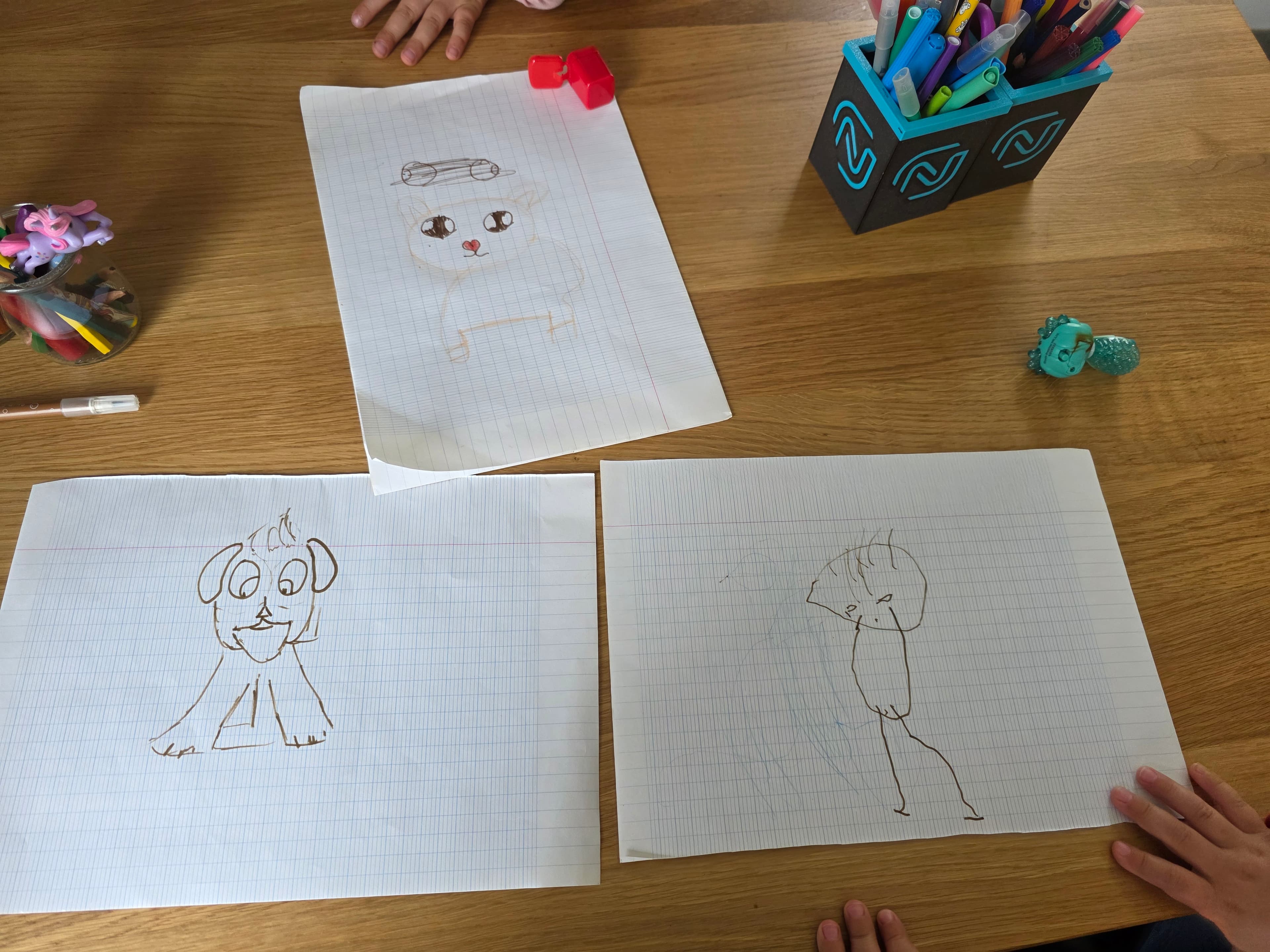
Meryl named his dog Charlie.
On the page, you had to take it on faith. The shape wasn't obvious. But Meryl had no doubts. It was Charlie. And once a child gives their drawing a name, explaining that the dog is a failure becomes a bad idea.
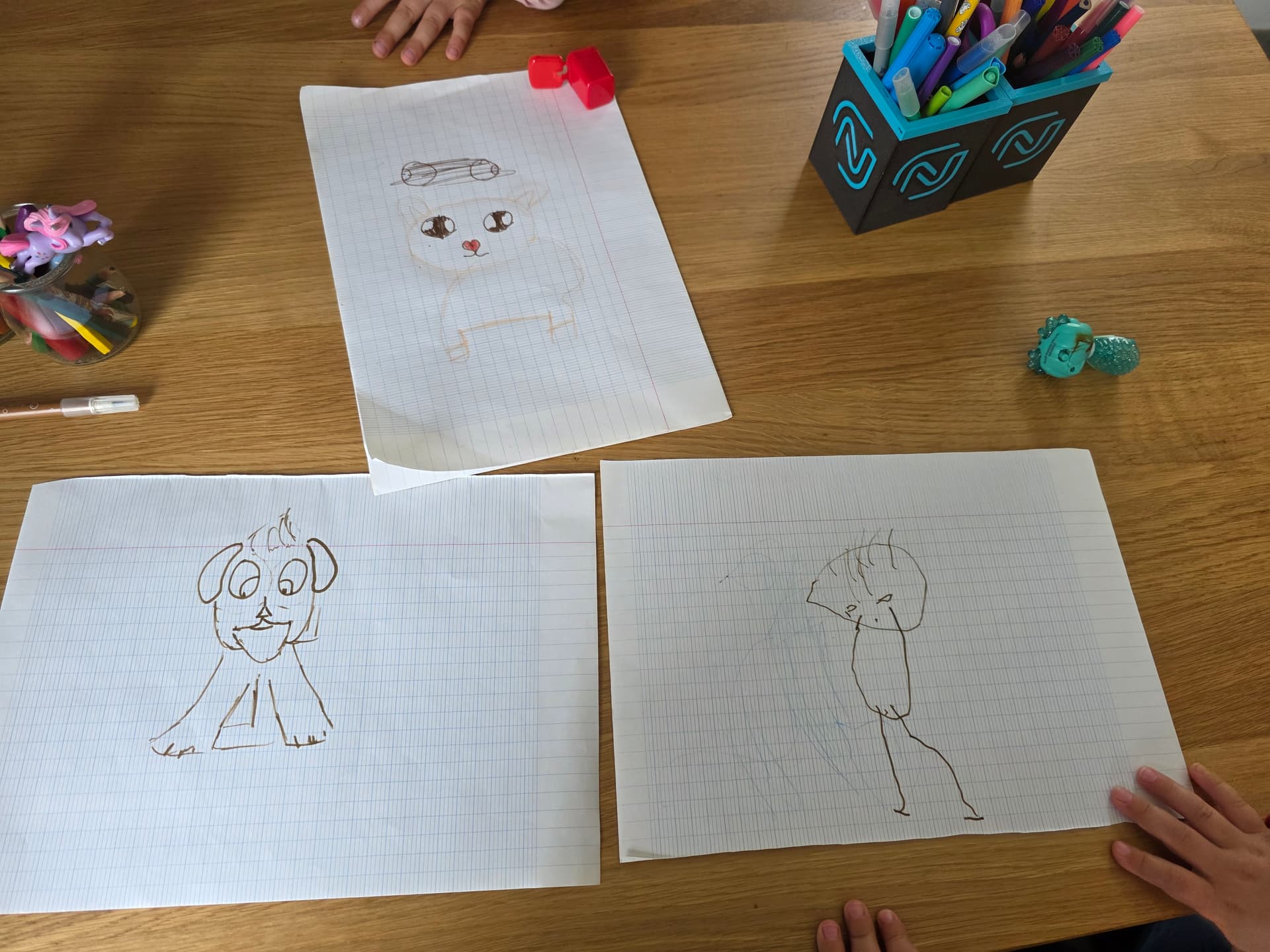
The three dogs. Hard to say which one failed.
How an AI learns to see
An AI that recognises dogs wasn't born knowing what a dog is. It was shown a lot of images. Over time it learned which details come up most often: ears, muzzle, the shape of the body. That process is called training.
But recognising and producing aren't the same thing. I can recognise a dog perfectly well. That doesn't mean I can draw one. I'd underestimated that gap.
It's true for AI. It's true for us. The brain that identifies and the brain that makes things aren't the same circuits. You can have seen ten thousand dogs without ever learning to build one.
The activity
Blank paper, pencils, no reference. The instruction is simple: draw a dog. No pressure, no judgment. The adult draws too. That part matters.
Then look at all the drawings together. Not to pick the best one. To ask: what makes us say this is a dog? The ears? The tail? Or just someone stating it with complete confidence?
What actually happened
Romane's dog looked like a cat. Not entirely. But enough to hesitate. She knew what she wanted to draw. Between the image in your head and the line on the page, there's a gap: ears that drift, a body that can't decide if it barks or meows.
I drew too. I thought it would be easy. On paper, my dog looked like it had escaped from a tired old cartoon. Not much more convincing than the kids'. Which was reassuring for them.
Meryl wasn't in that headspace at all. He drew. He held his idea. He gave it a name.
"Charlie."
Three and a half. No hesitation.
I have a recording of that moment.
Romane was looking for the right shape. I was trying not to embarrass myself. Meryl already had the dog. He even had its name.
To finish
At the end there were three dogs on the table. Romane's, which looked a bit like a cat. Mine, which didn't make me want to change careers. And Charlie.
An AI trained on millions of images can recognise a dog far better than I can. It can even generate one that looks exactly like a dog.
But I wonder if it would understand what had just happened at that table.
Or if it would simply say: "dog, medium confidence."