The flamingo had received a letter.
That's where we started. No draft, no title. Romane had decided the flamingo was writing back to Lili the rabbit. I picked up a pen to take down what she was going to dictate.
But before we could start, there was a problem to sort out.
"She has no thumb."
Lili the rabbit has no thumb. She can't hold a pen. So she can't have written a letter. So the flamingo can't reply. The logic was airtight.
We decided Lili had written with her magic wand. That let us move forward.
Romane couldn't ignore the inconsistency. At six, the brain checks the internal logic of worlds it knows. That wasn't stubbornness. That was rigour.
What AI does when it "writes"
When an AI generates text, it doesn't start from nothing. It has absorbed millions of letters, dialogues, novels, messages. And when you ask it to write in a character's voice, it builds something that looks like what you'd expect, from everything it has already seen.
It doesn't really understand what it's writing. It doesn't know who Lili is. It doesn't know what a flamingo would want to say to a rabbit. But if you give it the information, it produces a letter that holds together.
Maybe that's the magic wand. We don't really know what's happening inside. But something comes out anyway.
The activity
Suggest to the child that they write a letter between two imaginary characters, or ones borrowed from stories they already know. A letter those characters never really wrote.
To get things started, a few examples out loud are enough: a knight writing to his horse, a dragon writing to his cave, a fairy writing to her broken wand. It shows that anything goes and the letter doesn't need to be long.
For children who are just starting out or freeze at a blank page: you can work as a pair. The child gives the ideas and the words, the adult writes it down. The letter still belongs to them. The words are theirs.
At the end, you can ask: "Do you think an AI could write a letter like this one?" Let them answer before explaining anything.
What actually happened
Romane dictated, I wrote.
The letter was short. The flamingo confirmed it had received Lili's letter. It invited her to come over the next day. And it asked her to bring a chocolate cake.
Signed: the flamingo.
The cake request was non-negotiable.
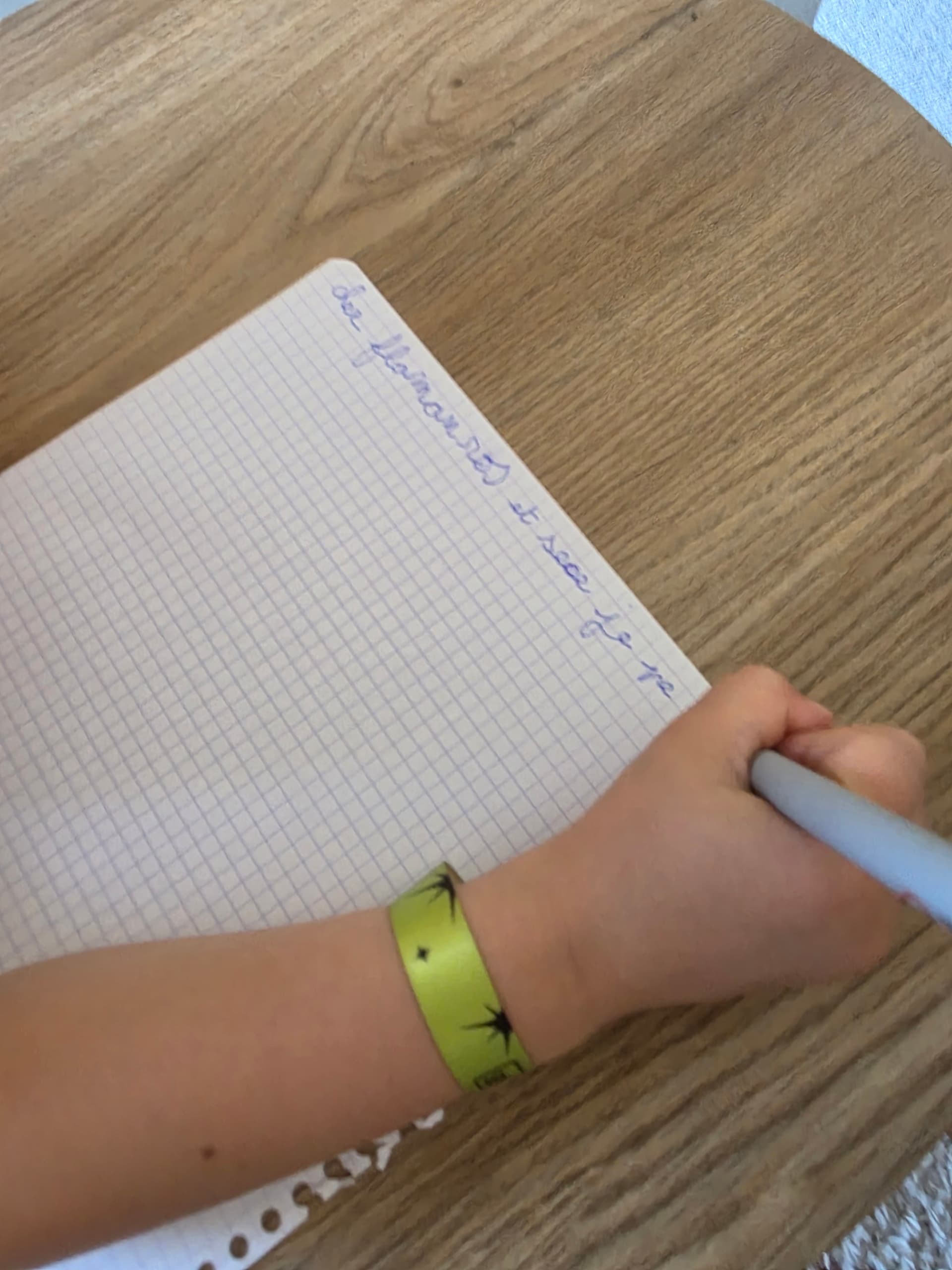
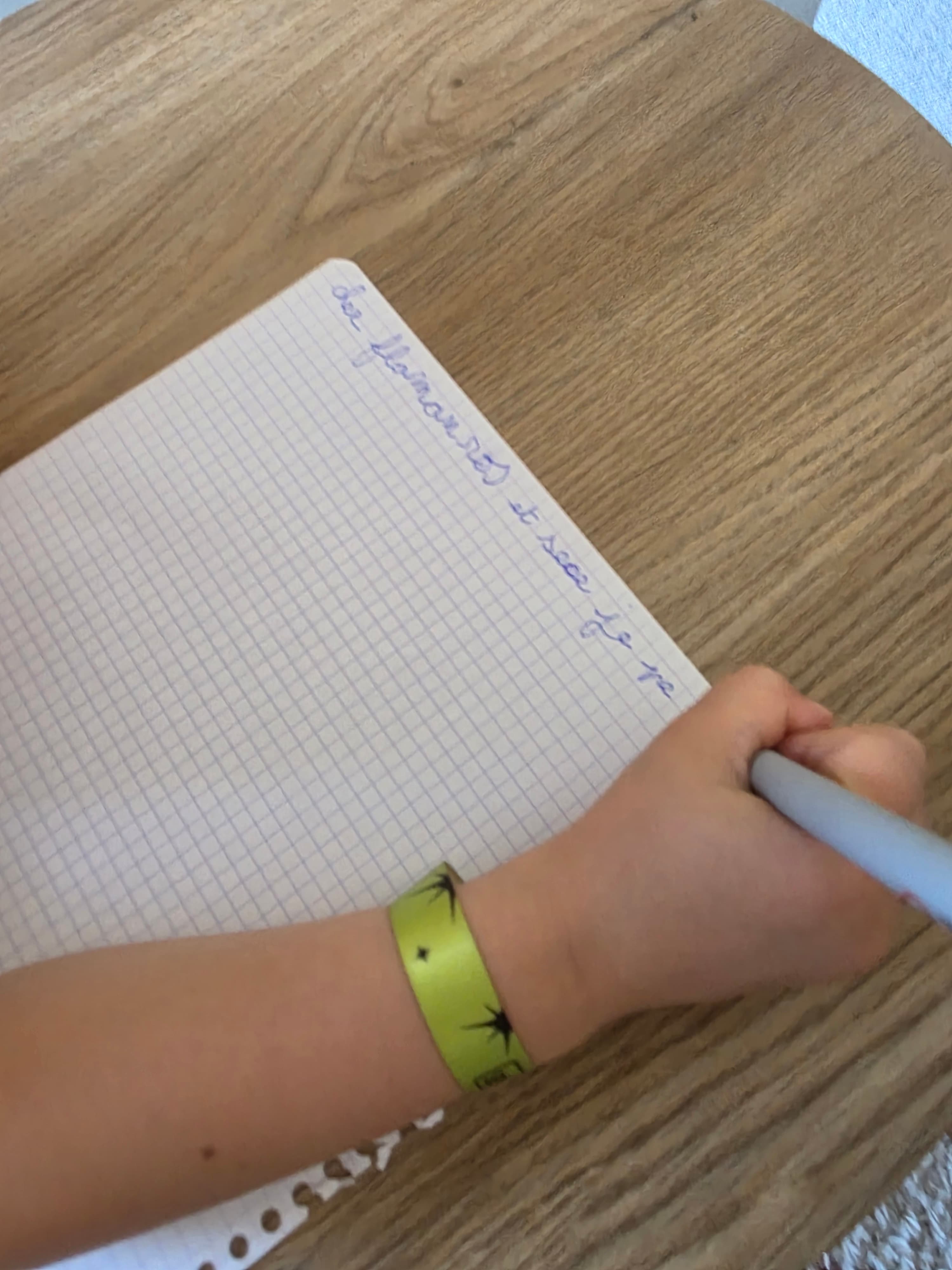
The flamingo's letter. Romane's handwriting.
The chocolate cake request wasn't in my opening examples. I noticed afterwards.
What an AI would probably produce: a well-turned letter, with a greeting at the start and a sign-off at the end. It wouldn't ask for a cake. It wouldn't have thought of it, unless you told it to include a specific request, which changes everything.
Romane knew what the flamingo wanted. She was the flamingo.
To finish
The thumb problem took longer than the letter itself.
Would an AI have raised the question? Probably not. It would have assumed Lili could write, or ignored the detail. It wouldn't have had a reason to stop there.
Romane couldn't ignore it. She knows Lili the rabbit. She knows what she can do and what she can't. And when something doesn't work in the logic, she says so.
AI can write the letter. But it wouldn't know whether Lili has a thumb.