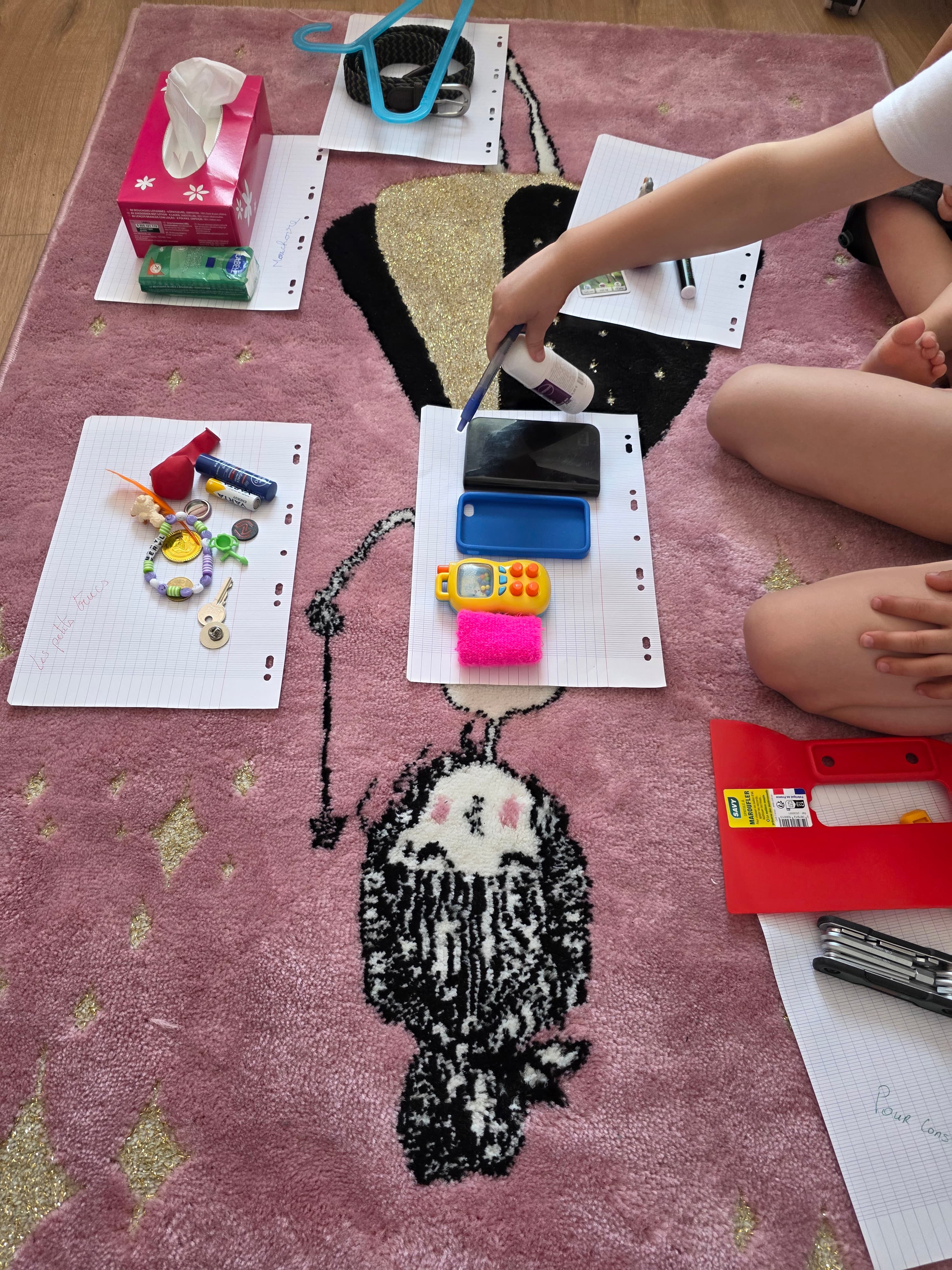
Romane had written "Small things" on a sheet of paper.
Next to it, another one: "For building."
On the pink rug we'd put a box of tissues, a blue hanger, a belt, some keys, a toy phone, a red shovel, a plastic hammer and a pile of objects that hadn't asked to be there. Meryl mostly wanted his phone back.
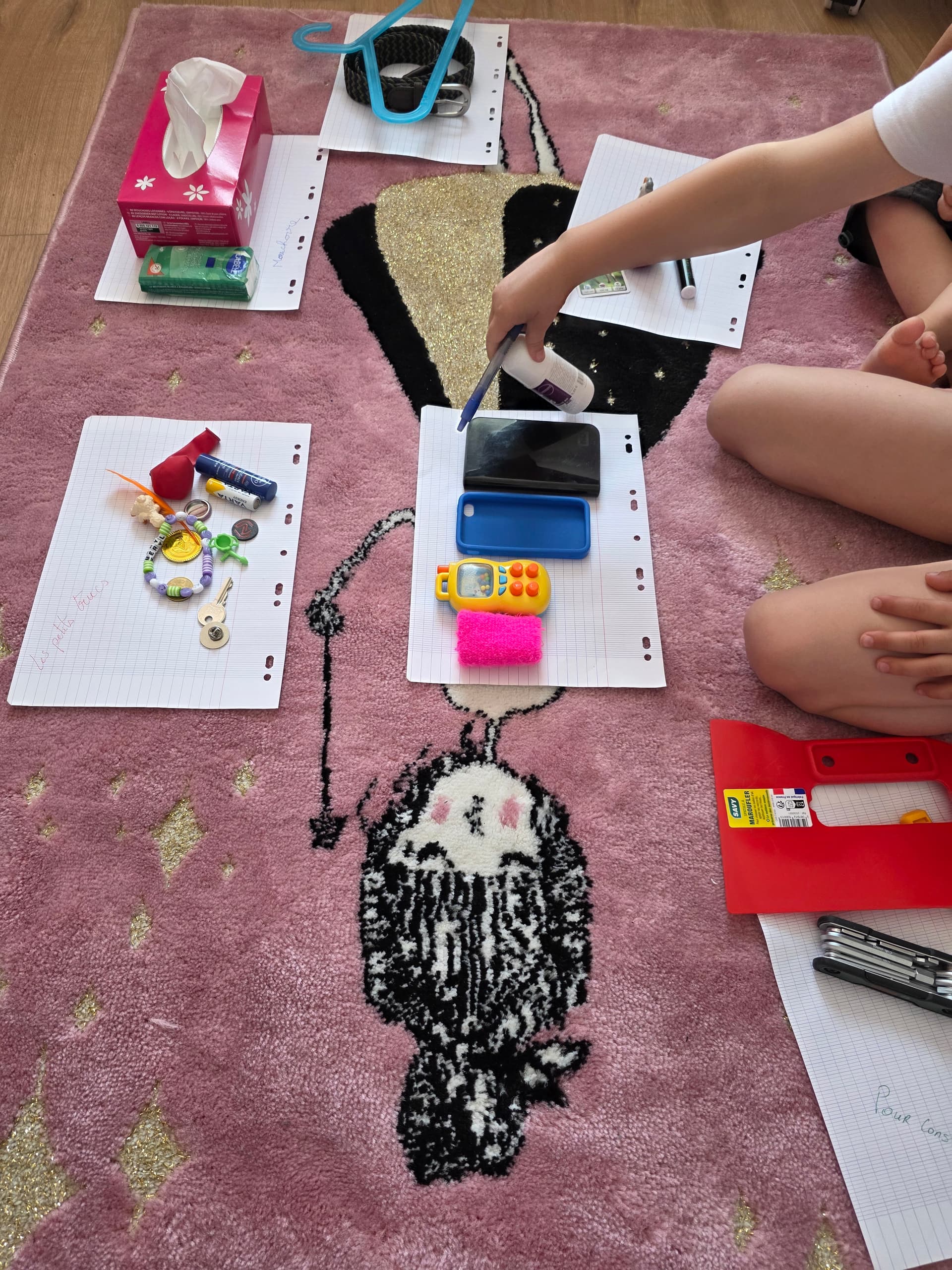
The pink rug, the objects, the categories. "Small things" on the left.
What AI actually does
When an AI recognises something (a photo of a cat, a spam email, an object), it looks for common features and sorts into categories. That's called classification.
But the real point is the criterion. Because the same object can belong to different groups depending on what you're looking at. A key can go in "small things," in "metal objects," in "things that open something," or in "things not to leave with Meryl." It all depends on the rule you choose.
An AI doesn't see everything. It looks at what it was trained to look at.
The activity
Gather some everyday objects, no need for them to be related. Lay out sheets of paper on the floor for categories, and let the kids write the labels themselves.
The most interesting part: ask one of them to make two piles using a secret criterion. The others try to guess the rule. It's harder than it sounds.
What actually happened
Romane quickly understood that sorting depends on the criterion. She wasn't just tidying, she was sorting according to an idea. Small things together, building things together.
Then she made two piles in silence.
I looked. I suggested a rule. I was wrong.
She explained: things that go in a cupboard, and things that don't.
I was the adult. I had all the objects right in front of me. I didn't have the rule. So I didn't get it.
Meryl was following a different logic. "Logic" might be a strong word.
Romane watched him and said: "He's just doing whatever."
Which was true. Sort of.
Because Meryl ended up with three piles: what he doesn't like much, what he likes, and what he quite likes.
I couldn't tell the difference between the last two. Neither could Romane. But for Meryl, they were clearly not the same.
At this age, the brain builds its categories of the world for real, not as practice. His three piles weren't random. They were his way of putting something important in order.
To finish
A classification can be completely clear to the person making it and totally opaque to everyone else.
If you trained an AI on Romane's criteria, it might look for what goes in a cupboard. Trained on Meryl's, it might learn something else.
What I like. What I quite like. What I don't like much.
And at that point, even an AI might need a little help.